

Immediately
Pick one job and take it off their plate.
First 48 hours
Help organize communications and food.
First month
Set up a care calendar like Rallee to organize scheduled care and manage communications.
Through the long middle
Set a reminder for month three and month five. Cancer can be a long journey. Stick by your loved one for the long haul.
After treatment
Keep checking in and support new needs that arise. Your loved one can be fatigued and exhausted after treatment.
What to expect when supporting someone through chemotherapy
Get familiar with these example timelines as you walk through this experience with a friend or loved one.
How long one session takes
Minutes to hours
Chemo treatments can last minutes or hours at the hospital or cancer center. Continuous infusion chemo can be given over a few days or weeks and is delivered through a pump you wear or carry.
What a cycle can look like
2 weeks on, 1 off
ACS gives this as an example of a three-week cycle. Treatments may be daily, weekly or monthly. Get the actual dates and you can build a schedule around them.
When fatigue is worst
The days after
ACS says "Fatigue starts in the days after a chemotherapy treatment and usually gets better before your next treatment." Treatment day is rarely the hardest one.
How long nausea usually lasts
24 to 48 hours
NCI adds that it can begin "a few minutes to a few hours after treatment begins" or be "delayed and occur a day or more after," and that some people feel sick for up to 7 days.
When infection risk peaks
7 to 10 days
The nadir is when white blood cell counts reach their lowest point after a dose. Typically this happens 7 to 10 days after a chemo treatment. ACS says it "is when a person is most at risk for a severe infection." Be mindful of this for food safety and exposure to others.
How long fatigue outlasts treatment
Weeks or months
According to ACS, "Some people report that their fatigue lasts for weeks, months, or even years after they finish cancer treatment." The last day of treatment is not the day they are automatically back to 100%.
These are the typical patterns, not a schedule. Regimens differ, and so do people: some sail through a cycle that deeply affects someone else. Treat these examples as a starting point.
Cancer support checklist: what to organize at each stage
Often, support can surge right after a diagnosis or after the first treatment session. However, it is important to continue to stick with your friend or loved one throughout treatment.
| Stage | What the family is dealing with | What to organize |
|---|---|---|
| First 48 hours | Shock, appointments, and repeating the news to everyone who calls | Start a Rallee so the recipient and family have one place to share updates and organize a care calendar. Give a DoorDash gift card or sign up for a specific need the recipient asks for. |
| First two weeks | Scans, staging, treatment planning, insurance calls | A schedule people can sign up to. Childcare and pet cover for appointment days. Someone to handle the admin. |
| Weeks 3 to 8 | Treatment starts. A rhythm emerges. Side effects arrive. | Meals timed to the treatment cycle. Rides to infusion. A regular slot rather than one-off gestures. |
| Months 3 to 6 | Exhaustion. Visitors have stopped. Finances are biting. | Keep going. This is where support collapses and where it matters most. Recheck what is actually needed now or ask the recipient if they would like to start a crowdfund on their Rallee. |
| End of treatment | Relief, fear of recurrence, and a sudden absence of structure | Do not disappear. The "you must be so relieved" period is harder than people expect. |
The first 48 hours: what to do when someone has cancer
Take something off their plate entirely. It could be a meal, rides for the kids, or creating a care page so they can easily update their community.
Asking "let me know what you need" or "let me know if you need help with anything" is not actually helpful. It adds work to their already heavy plate.

Some people don't feel comfortable asking for help, or the list of things they need help with may seem too long and overwhelming. So, instead of asking what you can do to help, it's usually better to find a concrete way to support your friend or loved one.
So offer something specific and time-bound. "I'm bringing dinner Thursday at six, I'll leave it on the porch" can be accepted with one word.
Three things that help immediately
- Set up one place for updates. The phone becomes an instrument of exhaustion within about a day. Every call is well meant and every call requires them to narrate the worst thing in their life again, adjusting the tone for who is asking. A single page like Rallee, where they write once and everyone reads, helps them scale communications and decreases the emotional toll of sharing the same news 30 times. Memorial Sloan Kettering suggests a related move for people who prefer not to post publicly: set up a phone team, so one friend takes calls and relays news outward instead of the patient doing it thirty times.8 Our guide on how to share health updates with family and friends has templates for the first update and the ones after it.
- Handle food for three days. Not a meal train yet. Just make sure there is something in the house tonight and tomorrow. When you are ready for more, here is how to plan a meal train for someone with cancer.
- Take one job entirely.Pick something to help with and own it without discussion: walking the dog, taking out the trash, dropping kids off at school, mowing the lawn.
If you are stuck on what to write
The American Cancer Society's advice is that "the most important thing is not what you say, it's that you're there and willing to listen."6 Sending something imperfect beats sending nothing, which is what most people do.
The first two weeks: how to help a family with cancer
This stretch is mostly appointments and uncertainty. Staging scans, treatment planning, second opinions, and a lot of phone calls with insurers.
The family often does not yet know what the next six months look like, which makes planning hard for everyone. What you can do without knowing the plan:
- Build the schedule now, fill it later. Set up a care page like Rallee and share updates. You can add support types like meals, rides, childcare, pet care, or donations when setting up the page or later. Invite your friends and family to the Rallee so they are all ready to support as needs arise.
- Collect the offers. Everyone is texting the family right now. Volunteer to be the person who fields that so they do not have to answer thirty messages individually.
- Support the recipient on appointment dates. Childcare, dog walking, and a driver are all highly practical needs you can help with.
- Go with them and take notes. UT MD Anderson names note-taking at appointments as a concrete way to help.7 A second set of ears in a consultation is worth a great deal, and writing things down is a job the patient cannot do well while being told difficult news.
- Ask about the calendar, not the diagnosis. "When's the next appointment and do you need a driver" is easier to answer than "how are you doing."
- Identify the support staff at the hospital. Many hospitals have an oncology social worker, a patient navigator, and a financial counselor to support the patient through treatment.
Helping a friend with cancer during treatment
Treatment typically lasts many months. Scheduling regular support for your friend or loved one is a great way to continue to support them during treatment.
Chemotherapy is often administered in cycles where the patient receives chemo treatment followed by rest. The length of chemotherapy sessions and duration of treatment depend on cancer type, the goal of treatment, the drugs used and how the person's body responds.1
Inside each cycle there is a predictable low point where the body's white blood cell count is at its lowest, called the nadir. "The nadir usually occurs about 7 to 10 days after getting chemo. This is when a person is most at risk for a severe infection," according to the American Cancer Society.2
Important dates to ask for
Ask your friend or their family for the infusion dates. Once you know them, you can build a care schedule or fill in the needs your friend shares.
| Where they are in the cycle | What is usually happening | What to schedule |
|---|---|---|
| Treatment day | An infusion appointment that can take several hours. NCI advises preparing for fatigue "by asking someone to drive you to and from chemotherapy."1 | Give them a ride to the hospital. Stay with them during the infusion (if welcomed). Offer to watch the kids or give them rides. Send them a DoorDash or grocery gift card so they can choose a meal or groceries whenever their appetite is ready for it. Deliver a meal for family members.Help with kidsHelp with petsProvide transportationShare updatesGive a giftDeliver a mealVisit |
| The next 2 to 3 days | Often the heaviest days for fatigue and nausea. Appetite is unreliable. | DoorDash or grocery gift cards. No visitors unless explicitly invited. Household jobs taken over entirely: yard work, taking out the trash, laundry, rides for kids, or dog walking.Help with petsHelp with kidsProvide transportationRun an errandGive a giftShare updatesCustom support |
| Roughly days 7 to 10 | Typically, this is the timeframe where your friend is the most immunocompromised. So, they may be extra cautious about food safety, going to spaces with large crowds, and accepting visitors.2 | Doorstep drop-offs for any flowers, gifts, cards. Do not plan on visiting. Do not come if you have been unwell. Anything you can help with outside of the house like walking the dog, doing yard work, checking in virtually (if welcomed), or binge-watching a great show while on FaceTime or on Google Meet.Check inHelp with petsGive a giftGive flowersShare updatesCustom support |
| The rest of the cycle | Starting about 10 days after chemo, they may start to feel a little more like themselves. This is usually the best stretch in the cycle. | The social activities (if welcomed). A walk, a movie, a normal conversation that is not about cancer. Bulk cooking for the next low week. Helping clean their place.Help cleanHelp with kidsDeliver a mealVisitCheck inShare updates |
You can organize care throughout the entire treatment cycle on Rallee. Rallee is fully customizable, giving you and your loved one the options to turn on and off support when needed.
Months 3 to 6: how to support someone through a long cancer journey
Stick with it. Your friend is going through the long middle (months 3-6). Often, this is where support from their community starts to dwindle.

By month 3, the support has thinned out, the visitors have slowed, and the family has settled into a routine that is grinding rather than dramatic. The diagnosis is old news to everyone except them. Money has usually started to bite, because treatment costs and lost income compound with nobody outside the household noticing. This is where adding donations to the care page may be beneficial.
NCI's summary on financial toxicity describes the pattern: some survivors report spending more than 20% of their annual income on medical care, and people working through treatment missed about 22 more workdays a year than people not in treatment.14
- Set a reminder now. Put one in your phone for month three and month five. Willingness fades on its own, but a calendar entry can serve as a great actionable reminder.
- Recheck what is needed. The answer in month four is rarely the answer from week one. Check the care page and follow the updates from the family to identify support that you can help with.
- Keep the schedule running at a lower rate. Two meals a week for six months beats daily for three weeks.
- Take on a money or paperwork job. This is the help that shows up exactly when everyone else's has stopped. Paperwork sucks, but some people are blessed to do this work. If you are one of them, you are a hero to us all.
- Notice the caregiver. By month four they are usually worse off than anyone has registered. Give them a break, a massage gift card, a spa day, or a day at the movies.
What to say to someone who has cancer, and what not to
Most people freeze because they are frightened of saying the wrong thing, and then say nothing, which is worse than almost any wrong thing.

What lands
"I'm so sorry. I'm here." "I'm thinking about you and I don't need a reply." "I'm bringing food Thursday." "Do you want to talk about it or would you rather talk about anything else?" Naming the thing directly rather than talking around it. Continuing to treat them as the person they were. UT MD Anderson lists practical ways to help, including having normal conversations and simply sitting and listening, which are easy to dismiss and hard to do well.7
What tends not to
Three of these come from the organizations themselves, not from us.
- "I can imagine how you must feel." The American Cancer Society advises against it, "because you really cannot."6
- Telling them how strong they are. ACS notes this can leave someone feeling obliged to keep performing strength when they are exhausted.6
- Comparisons to other people's outcomes. Memorial Sloan Kettering gives the exact form to avoid: "Don't say, 'My friend was diagnosed with stage 4 [colon cancer], too, and they're doing great.'"8
- "Everything happens for a reason."
- Unsolicited treatment suggestions, supplements, diets or articles.
- "Let me know if you need anything." It moves the work back onto them.
- Asking for medical detail they have already explained forty times.
The most common error is talking about the diagnosis instead of the person. The second most common is disappearing because you do not know what to say.
If a conversation worries you
NCI reports that "nearly half of people with cancer report having a lot of distress," and that a care team will screen for it and can refer someone on.11 The useful response is not to solve it. It is to ask whether they have talked to their team, and to offer to help them make that call.
What food to bring someone with cancer, and what to avoid
Meals can help a ton or be an overwhelming pile of casserole. Personalize your meals and your timing before you start cooking. Consider your loved one's tastes, desires, allergies, food safety, and members of the family before sending any food their way.

Let's be totally real here: a DoorDash or grocery gift card may be your best bet. You may be an amazing cook in the kitchen, but if you cook something that your friend with cancer never feels like eating, it will be entirely wasted.
During cancer treatment, taste, appetite and food safety all change through each cycle, so what helps in week two of a cycle is different from what helps on day two. If home-cooked meals are welcomed, remember to deliver them in small portions with mild flavors in disposable containers. Always disposable containers. Check before sending food at all, because treatment can change what someone can tolerate and an unwanted delivery becomes another thing to manage.8
What not to bring when immune systems are compromised
The American Cancer Society publishes food safety guidance for people whose white blood cell counts are low and immune systems are compromised. The list below is drawn from that page.9 Ask the family whether it applies and what their comfort level is around home-cooked meals and meals that deviate from this guidance.
| Avoid | ACS guidance | Bring instead |
|---|---|---|
| Raw or lightly cooked fish and shellfish | Specifically "lox, sushi, or sashimi" | Fully cooked fish. But also be cool and check before bringing filets of potent fish after a chemo treatment. |
| Runny eggs | "Cook eggs until the yolks and whites are solid, not runny" | Hard-boiled, or a fully set frittata |
| Undercooked meat and poultry | Whole meats to 145°F, ground meats to 160°F, poultry to 165°F | Anything braised, stewed or roasted through, with the temperature checked |
| Soft and blue-veined cheeses | "Brie, Camembert, Roquefort" and other mold-ripened cheeses | Hard, pasteurized cheeses |
| Unpasteurized dairy and juice | Raw milk and eggnog; "avoid 'fresh-squeezed' juices" | Pasteurized milk and juice |
| Raw sprouts | "Any raw vegetable sprouts (including alfalfa, radish, broccoli, or mung bean sprouts)" | Cooked vegetables |
| Salad bars, delis and buffets | "Do not eat from high-risk food sources, such as salad bars, delicatessens (deli), buffets and smorgasbords" | Food you cooked yourself, or a sealed order from a restaurant kitchen |
| Raw nuts, fresh nut butters, raw honey | Avoid raw nuts, fresh nut butters, and honey | Commercially processed nut butter and pasteurized honey |
| Anything that has sat out | Refrigerate at or below 40°F. Egg, cream and mayonnaise-based foods should not sit unrefrigerated for more than an hour. Eat leftovers within 3 days. | Delivered hot and eaten within the hour, or chilled with a date written on the lid |
Wash your hands with warm, soapy water for 20 seconds before and after preparing food. And, because it comes up constantly in family group chats: ACS states plainly that "you can't raise your white blood cell counts by avoiding or eating certain kinds of foods."9 Food safety matters. Sending someone a diet that promises to fix their counts only adds a burden.
Label everything
What is in it, the date it was made, and whether it contains anything commonly avoided. It takes ten seconds and it means nobody has to phone you to ask.
Organizing meals for the whole treatment? Our guide to a meal train for cancer patients covers what to bring on each day of a chemo cycle, food by side effect, and how to keep meals coming for months.
More ways to help someone with cancer
Pick the kind of help that fits you. Each tab covers one practical job you can take off their plate.
Getting to and from treatment
Rides are among the most valuable things to offer during treatment.

An infusion appointment often runs several hours. Offer to give a ride to and from the hospital so your loved one doesn't have to worry about it. There are also great services and options below that you can offer.
| Option | What it is | How to arrange it |
|---|---|---|
| A Rallee to organize support | Friends sign up to give rides, meals and more during important dates like treatment appointments. | Start a Rallee for your friend and select "Transportation" as one of the ways they need support. Invite friends and watch the support pour in. |
| ACS Road To Recovery | Volunteer drivers giving "free rides to cancer-related medical appointments." Not available everywhere, and other eligibility rules can apply.16 | Call 1-800-227-2345. ACS says "it can take several business days to coordinate your ride, so please call us… well in advance of your appointment date."16 |
| The treatment center's own transport | Many cancer centers run a service or hold vouchers and rideshare credits they do not advertise | Ask the oncology social worker or patient navigator, not the front desk |
| Medicaid non-emergency transport | Federal rules require state Medicaid agencies to specify in their state plan that they will "assure necessary transportation for clients to and from providers."17 How it works differs by state. | Call the number on the Medicaid card, or ask the hospital's social worker to start it |
| Free lodging near treatment | ACS Hope Lodge offers free rooms for patients and a caregiver in 31 Hope Lodge cities across the US and Puerto Rico.18 Joe's House, a nonprofit, lists discounted lodging near treatment centers nationwide.19 | Hope Lodge: apply on the ACS site or call 1-800-227-2345. Joe's House: search by hospital at joeshouse.org |
| Free air travel for distant treatment | Air Charity Network coordinates volunteer pilots. Corporate Angel Network arranges seats on corporate aircraft. | Apply directly. Both need lead time, so start before the appointment is booked |
If none of that applies, ask the treatment center's social worker or patient navigator what exists locally.
Children, pets and the house
Cleaning, housework, pet care and rides for kids all take a significant amount of time and energy. Helping with any of these tasks could take a lot of stress off your friend.
- Childcare on treatment days and the two days after. Predictable and repeating beats ad hoc.
- School logistics. Pickup, drop-off, permission slips, and packed lunches.
- Pets. Walking, feeding, vet trips, and cover during hospital stays.
- The house. Taking out the trash, mowing the lawn, doing the laundry, and helping clean the house.
- Groceries. Pick up groceries for the family. Get the essentials or get a list from the family.
If there are children
The American Cancer Society's guidance is to keep routines as consistent as possible and to arrange reliable daily care when it is a parent who has been diagnosed.20 That is a job a friend or neighbor can hold: the same person doing the same school run on the same days, for months, so that one part of a child's week does not move.
ACS also points to the adults already around a child, naming "school counselors, teachers, coaches, scout leaders, or even trusted friends and neighbors" as people who can offer support once they know what is happening.20 Telling the school is often the single most useful call a friend can make on a family's behalf, with their permission.
ACS notes that there are local and national camps and support groups for children whose parent has been diagnosed, including Kesem, which runs through local chapters.20
Money, insurance and paperwork
Extra credit! Taking on paperwork is a massive help for friends going through an emotionally draining time.

Treatment generates an enormous amount of paperwork, and it arrives at the exact moment the household has least capacity. Claims, denials, appeals, prior authorizations, billing errors, and applications to assistance programs. Someone organized who is not emotionally wrung out can take this on.
NCI's summary on financial toxicity describes what is at stake. Some survivors report spending more than 20% of annual income on medical care. Some report "skipping doses or taking less medicine than prescribed, to make their prescription last longer and save money." NCI also notes that "the higher the copayment, the less likely patients are to take their medicine as directed," and lists job loss, reduced hours, difficulty returning to work and lost income among documented consequences.14
Three levers most families never use
1. The hospital's own financial assistance policy. Most nonprofit hospitals in the US are required to have one, and to tell people it exists.
Under section 501(r)(4) of the Internal Revenue Code, a tax-exempt hospital must have a written financial assistance policy setting out "eligibility criteria for financial assistance, and whether such assistance includes free or discounted care," how charges are calculated, and "the method for applying for financial assistance." It has to publicize the policy widely, put it on a website, and give out free paper copies on request. Anyone who qualifies cannot be charged more than amounts generally billed for emergency or medically necessary care.15
Asking for that policy by name and helping fill in the application is an afternoon's work for a friend.
2. Job-protected leave. The Family and Medical Leave Act provides eligible employees up to 12 workweeks of leave in a 12-month period, including "to care for the employee's spouse, child, or parent who has a serious health condition." It applies to private-sector employers who employ 50 or more employees in 20 or more workweeks, and the employee must have worked for the employer for at least 12 months with at least 1,250 hours of service in the previous 12 months.21 This matters for the caregiver as much as the patient, and the paperwork is exactly the sort of thing a friend can chase. State leave laws can be more generous; Triage Cancer publishes a state-by-state chart.23
3. Free professional help navigating insurance. CancerCare's services, including counseling by professional oncology social workers, support groups, and financial and co-payment assistance, are free.22 Patient Advocate Foundation provides case management for people with chronic, life-threatening and debilitating illnesses across more than 750 diagnoses.24
Practical ways in for a friend
- Offer to be the person who opens the mail and sorts it into "needs action" and "filing"
- Track bills against explanation-of-benefits statements. Billing errors are common, and an EOB is not a bill.
- Ask the hospital, in writing, for its financial assistance policy and application15
- Help the caregiver file FMLA paperwork before they need the leave, not after21
- Search for assistance programs by diagnosis and location. CancerCare's A Helping Hand database is the best single starting point
- If you are raising money, be clear where it goes. Supporters give more readily when they understand exactly what they are funding
Ask the treatment center whether they have a financial navigator or financial counselor.
Supporting the caregiver
The spouse, parent or adult child holding this together is usually the person furthest down everyone's list, and by month four they are often in worse shape than anyone has noticed.
Even the official language puts them inside the illness. The National Cancer Institute's Office of Cancer Survivorship defines survivorship as "a state of being, including the perspectives, needs, health, and the physical, psychological, social, and economic challenges experienced by people and caregivers after a cancer diagnosis."25
The scale of the job, from the national survey data NCI summarizes: cancer caregiving lasted about two years on average; 50% of those caregivers were also employed, working an average of 35 hours a week; 50% reported high emotional stress and 25% reported high financial strain; 43% said they needed help managing their own emotional and physical stress.10
Many caregivers say that, looking back, they took too much on themselves. Or they wish they had asked for help from friends or family sooner.
NCI is blunt about what happens if nobody helps: "If you don't take care of yourself, you won't be able to take care of others." It also names the thing that keeps caregivers from asking: "All family caregivers need support. But you may feel that your needs aren't important right now since you're not the cancer patient."26
The tasks NCI suggests caregivers delegate are ordinary ones: "helping with chores, such as cooking, cleaning, shopping, or yard work" and "driving your loved one to appointments or picking up medicines."26 None of it takes a special skill. It takes picking one and keeping it.
- Ask about them, and stop there. Do not pivot to the patient in the same breath.
- Give them time out of the building. Sitting with the patient during infusion for two hours so the caregiver can walk outside.
- Take the invisible jobs. Scheduling, admin, and the mental tracking of who needs what and when.
- Do not make them the one who asks. Waiting to be asked may mean waiting past the point where it would have helped.
- Keep inviting them. They will say no most of the time. Being asked still matters.
Cancer center support staff: who can help patients and families
Cancer centers employ many different roles that help patients navigate treatment, resourcing, and support.
| Ask for | What they do | Ask them |
|---|---|---|
| Oncology social worker | A licensed social worker specializing in the psychosocial side of cancer. The Association of Oncology Social Work, an international nonprofit founded in 1984, exists to enhance "psychosocial services to people with cancer, their families and caregivers."27 | What help exists locally for transport, bills, childcare and counseling. Resourcing outside the hospital. |
| Oncology nurse or patient navigator | Guides a patient through the system and removes barriers to care. AONN+ is the largest national specialty organization for these roles, with more than 8,900 members since 2009. | What is coming next, what to prepare for, how to prepare for it. Resourcing inside the hospital. |
| Financial counselor or navigator | Handles the hospital's own billing, payment plans and financial assistance policy.15 | For the written financial assistance policy and the application form |
| Oncology dietitian | Advises on eating through treatment, including when counts are low.9 | What this person can eat right now, so the meal schedule is built on fact rather than guesswork |
| Palliative care team | ACS describes palliative care as "a special approach to caring for anyone with a serious illness, including cancer," which "can be given at any time during the cancer journey" and is often "offered as soon as cancer is diagnosed." It is not the same as hospice, which ACS describes as care "provided during the last phase of an incurable illness or near the end of life."28 | Whether a referral would help with symptoms and quality of life. |
If their center does not have these roles
Help also exists outside of the hospital. The American Cancer Society runs a 24-hour free helpline at 1-800-227-2345.16 The National Cancer Institute's Cancer Information Service is at 1-800-4-CANCER (1-800-422-6237), Monday to Friday 9am to 9pm ET, in English and Spanish, with live chat and email.29 CancerCare's oncology social workers are available at 800-813-HOPE (4673) and their services are free.22
How to support someone after cancer treatment ends
Everyone expects relief. What often arrives instead is a strange flatness and a new kind of fear.
NCI puts the most common one first: "Probably the most common fear is that the cancer will come back (a cancer recurrence)." Some survivors call the dread before a scan "scanxiety." NCI also names the social problem directly, which is the part friends cause without meaning to: "It can also be tough when others think you're ready to move on when you're not." And on timing: "Getting used to life after cancer treatment takes time."12
Through treatment there is structure: appointments, a plan, a team checking in. When it stops, the structure goes with it, and the person is left with a body that has been through a lot, a fear that has nowhere to go, and a community who assume it is over.
Do not disappear at the finish line. Keep checking in. Ask when the next scan is and put it in your calendar. And drop "you must be so relieved" from your vocabulary, because it tells someone which feeling they are supposed to be having.
One thing worth telling them, because it rarely feels true from the inside: they are not unusual. As of 1 January 2025 about 18.6 million people in the United States were living with a history of cancer, a number projected to pass 22 million by 2035.13
Cancer terms to know: a glossary for caregivers
You will hear these in conversation and on paperwork. Knowing them makes you more useful and stops the family having to explain.
- Cycle
- According to the National Cancer Institute, "A cycle is a period of chemotherapy treatment followed by a period of rest."1 The cycle is what you build a help schedule around.
- Nadir
- The low point of blood counts after a chemotherapy dose. The American Cancer Society puts it this way: "The nadir usually occurs about 7 to 10 days after getting chemo. This is when a person is most at risk for a severe infection."2
- Neutropenia
- A low count of neutrophils, a type of white blood cell that helps protect against infection. It can be caused by cancer itself or by treatments including chemotherapy.2
- Infusion
- Treatment given into a vein, often over several hours. NCI advises preparing for fatigue "by asking someone to drive you to and from chemotherapy."1
- Palliative care
- The American Cancer Society describes it as "a special approach to caring for anyone with a serious illness, including cancer," which "can be given at any time during the cancer journey." Not the same as hospice.28
- Survivorship
- According to NCI's Office of Cancer Survivorship, a person is "considered a cancer survivor from the time of diagnosis through the balance of life," and survivorship covers the challenges "experienced by people and caregivers after a cancer diagnosis."25
- Financial toxicity
- The financial harm caused by cancer and its treatment, which NCI documents as including debt, bankruptcy, skipped medication and job loss.14
- Prior authorization
- HealthCare.gov defines it as "a decision by your health insurer or plan that a health care service, treatment plan, prescription drug or durable medical equipment is medically necessary." Also called preauthorization, and getting it does not guarantee the plan will cover the cost.30
- Financial assistance policy
- The written policy a tax-exempt hospital is required to have under section 501(r)(4), setting out who qualifies for free or discounted care and how to apply.15 Ask for it by name.
- Patient navigator
- Someone whose job is guiding a patient through the cancer care system and removing barriers to care. AONN+ is the largest national specialty organization for oncology nurse and patient navigators.
Choosing an app to support a loved one with cancer
Whatever tool you use, make sure you can share updates and have the option to add support like meals, rides, childcare, help with pets, and crowdfunding. Make sure your app or tool has these qualities to make caring easy:
- Pick an all-in-one care app. Support can get messy if you are trying to manage one app for health updates, another for meals, and another for fundraising. Every extra link loses people along the way and makes it harder for the family to manage care.
- Easy ways to sign up to help and smart notifications. Friends pick the support they want to help with, and everyone gets a reminder before their date, so the organizer is not managing administrative tasks.
- It has to cover more than meals. Rides, childcare, errands, groceries, admin. Restrict it to food and you exclude everyone who cannot cook but would happily drive.
Easily organize care
Rallee: a free care app for organizing cancer support
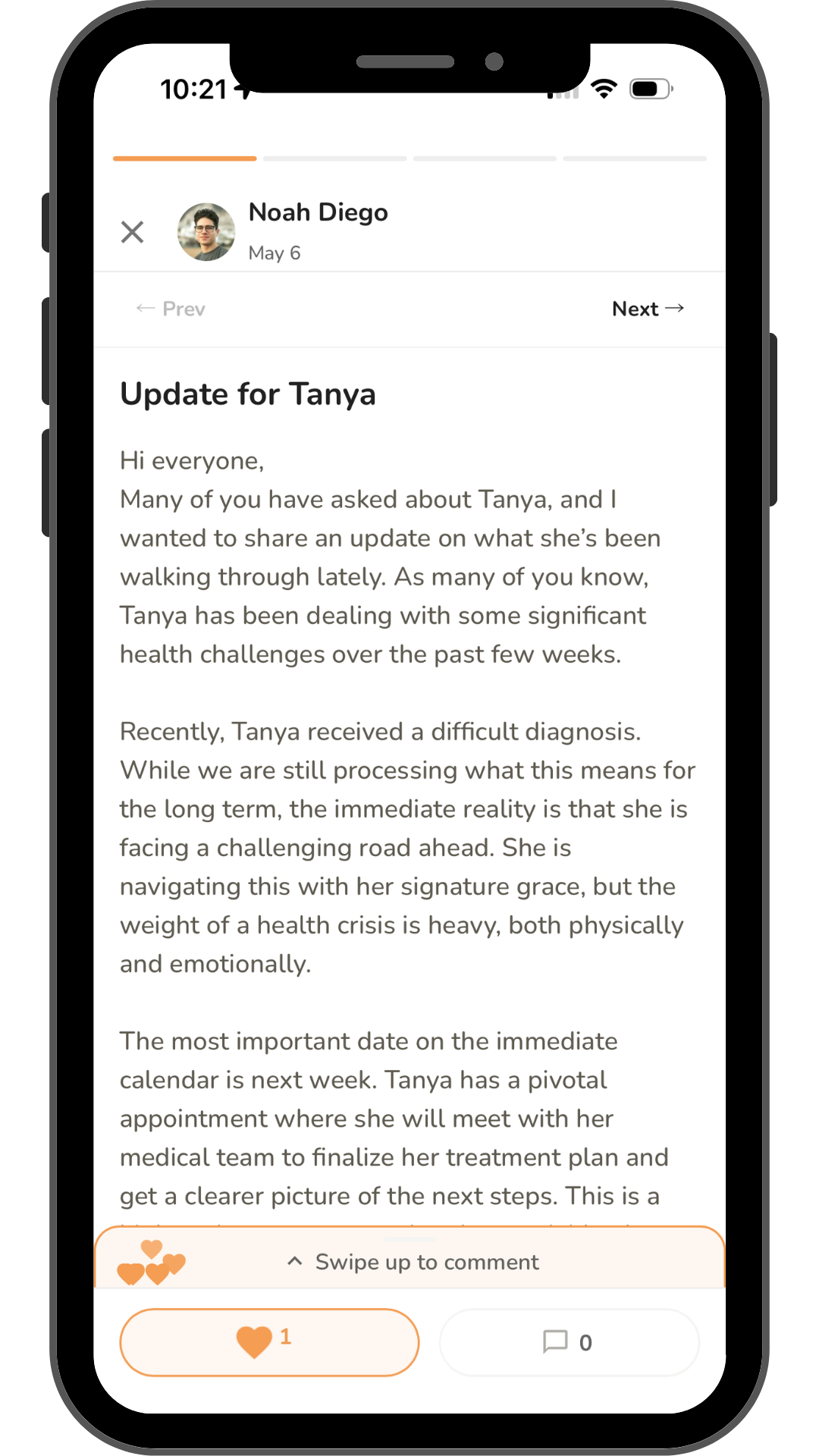
Start a Rallee in under 1 minute for your loved one going through cancer. Rallee is a free all-in-one care app that helps people organize support for loved ones going through a health challenge or other major life updates. On Rallee, you can share health updates, crowdfund, and start a care calendar so friends can help out by delivering meals, running errands, visiting, providing transportation and more. All support types are optional; you can choose as many as you need:
Share updates
Deliver a meal
Donate
Give coffee/tea
Give a gift
Provide transportation
Help with kids
Give flowers
Help with pets
Help clean
Visit
Check in
Run an errand
Unlimited custom support
Free, quick to set up, and no need to move anyone off what they already use.
More guides for supporting someone with cancer


Frequently asked questions about helping someone with cancer
What is the most helpful thing to do for someone with cancer?
Take one job off them completely, without asking. Meals, rides, childcare, the dog, the admin. UT MD Anderson gives the same advice: rather than asking what you can do, it is usually better to find a concrete way to support your friend or loved one. Specific and repeating beats general and one-off, and both beat “let me know if you need anything”.7
What should I not say to someone with cancer?
The American Cancer Society advises against “I can imagine how you must feel”, because you really cannot, and against telling someone how strong they are, which can leave them performing strength while exhausted. Memorial Sloan Kettering names comparisons to other people's outcomes as a thing to avoid. Add “everything happens for a reason”, unsolicited treatment or diet suggestions, and “let me know if you need anything”. The most common mistake is saying nothing at all because you are afraid of getting it wrong.68
How long does a family need help during cancer treatment?
Longer than the community expects. Chemotherapy is given in cycles and the National Cancer Institute says how long a course runs depends on the cancer type, the goal of treatment and how the person responds, so there is no single figure. In the national survey data NCI summarizes, cancer caregiving lasted about two years on average. Plan for months three to six, which is when help is needed most and offered least.110
When should I not visit someone having chemotherapy?
Avoid the window around the nadir, which the American Cancer Society says usually occurs about 7 to 10 days after a chemotherapy dose and is when a person is most at risk for a severe infection. ACS advice during low counts includes avoiding large crowds and people who are sick, and wearing a mask when going out. Ask first, keep it short, and do not go if you have been unwell. Memorial Sloan Kettering makes “ask before you visit” its first tip.28
What food should I not bring to someone having chemotherapy?
When white blood cell counts are low, the American Cancer Society advises avoiding raw or lightly cooked fish and shellfish including sushi and lox, runny eggs, undercooked meat, soft and blue-veined cheeses such as Brie and Roquefort, unpasteurized dairy and fresh-squeezed juice, raw sprouts, raw nuts and fresh nut butters, raw honey, and anything from a salad bar, deli counter or buffet. ACS also says leftovers should be eaten within three days. Ask the family whether this applies right now, because it does not apply the whole time.9
How do I help someone with cancer if I live far away?
Run the schedule, take the paperwork, and set up deliveries. Insurance appeals, hospital financial assistance applications and assistance-program searches all work over email and phone. A standing grocery order or a credit at a restaurant they already use takes one repeating decision off their week. And text without expecting a reply, saying so explicitly.15
Who at the hospital can help with money and transport?
Ask for the oncology social worker, the patient navigator, and the financial counselor. Under section 501(r)(4) of the Internal Revenue Code, tax-exempt hospitals must have a written financial assistance policy and publicize it, so ask for that policy and its application. For transport, ask about the center's own service, the American Cancer Society's Road To Recovery program on 1-800-227-2345, and Medicaid non-emergency medical transportation, which state Medicaid agencies are required to assure.151617
How do I organize help for someone with cancer?
Start one shared care page where the family posts updates and friends sign up for specific help, so nobody has to coordinate by text. Add the support types that fit, such as meals, rides to treatment, childcare, pet care and errands, and invite friends and family early so they are ready as needs come up. Get the treatment dates and plan help around each chemotherapy cycle, keeping visits away from the nadir, which the American Cancer Society says usually falls about 7 to 10 days after a dose. Then keep the schedule running through months three to six, when offers usually drop off. Using an app like Rallee helps organize all of this support in one place.2
What is the best app to organize help for someone with cancer?
Look for one app that keeps health updates in one place, lets friends sign up for specific help such as meals, rides, childcare and pet care, and offers donations with low fees. Rallee is a free all-in-one care app that helps organize support for people going through health challenges. Rallee does not have any ads, premium tiers, or solicitations to donate to Rallee.
What if they say they do not need anything?
People say that reflexively, and often because accepting help feels like an imposition. NCI's guidance for caregivers records the result: many caregivers say that, looking back, they took too much on themselves, or they wish they had asked for help from friends or family sooner. Do the specific thing anyway, keep it small, and do not make them thank you for it.26
What should I do when their treatment ends?
Keep showing up. NCI reports that the most common fear after treatment is that the cancer will come back, that some survivors call the dread before a scan “scanxiety”, and that it can be tough when others think you are ready to move on when you are not. Ask when the next scan is, put it in your calendar, and skip “you must be so relieved”.12
Cancer support resources for patients, families and caregivers
Before you work through this list
If the patient is being treated at a cancer center, start with the oncology social worker or patient navigator there. They will know which of these apply locally, and connecting families to exactly this kind of help is their job. Most families never find out they have one.
Start here, by phone
Patient and caregiver guidance, plus local programs including transport and lodging.
24-hour helpline 1-800-227-2345
The US government's cancer information service. English and Spanish, plus live chat and email.
1-800-4-CANCER, Mon to Fri 9am to 9pm ET
Free counseling from professional oncology social workers, support groups, and financial and co-payment assistance.
Hopeline 800-813-HOPE (4673)
A free, confidential referral line to local services, available 24 hours a day.
Dial 211 in most of the US
Understanding the support staff
An international nonprofit 501(c)(3) founded in 1984, dedicated to the enhancement of psychosocial services to people with cancer, their families and caregivers.
The largest national specialty organization for oncology nurse and patient navigators, with more than 8,900 members since 2009. Rallee collaborates with AONN+.
The equivalent body for families of children with cancer.
General information and support
Sections on caregiver support, adjusting to cancer, day-to-day life and survivorship.
The orientation page to send someone in week one.
Information, support and financial help for blood cancers. Formerly the Leukemia & Lymphoma Society, renamed in August 2025.
A personalized support and navigation team for brain tumor patients and care partners, covering clinical trials, treatment, financial help and grief support. Replies within 48 to 72 hours.
617-924-9997
Cancer support groups
Support groups meet in person at hospitals and community centers, online, and by phone. The oncology social worker at the treatment center will usually know what runs locally.
The National Cancer Institute's guide to in-person, online and telephone support groups, and how to find one.
Free, professionally led programs at more than 200 locations, including Gilda's Club centers, plus the MyLifeLine online community and a support helpline.
Free groups led by oncology social workers for patients, caregivers and the bereaved. Online groups are open to anyone in the US and its territories.
Free one-on-one support, matching patients, survivors and caregivers with a mentor who has been through a similar cancer.
The American Cancer Society's free app, connecting patients and caregivers with trained volunteers who share their diagnosis and background. It replaced Reach To Recovery.
Money, insurance and paperwork
This is the help nobody volunteers for, and often the help that changes a family's month. If you are the organized friend, this is where to put yourself.
A searchable database of organizations providing financial or practical help. The best single starting point. cancerfac.org, formerly the Cancer Financial Assistance Coalition, now redirects here.
Case management across more than 750 diagnoses, covering insurance denials, appeals, debt and job issues.
800-532-5274
Help with rent and housing, groceries, transport and utilities, plus financial planning.
Free education on the legal and practical issues after a diagnosis, including a state-by-state chart on leave, insurance and employment rights.
Diagnosis-specific help with copays, premiums and out-of-pocket costs.
Treatment copay assistance.
What a tax-exempt hospital's financial assistance policy must contain and how it must be publicized. Read this before calling the billing department.
A nonprofit database of patient assistance and medication cost programs.
Transport and lodging
Free rides to cancer-related appointments from volunteer drivers, where available. Call several business days ahead.
1-800-227-2345
What state Medicaid agencies are required to assure. Implementation varies by state.
Free lodging for patients and a caregiver in 31 Hope Lodge cities across the US and Puerto Rico.
A nonprofit listing lodging near treatment centers nationwide, with discounts for patients and families.
Free air travel to distant treatment via volunteer pilots.
Seats on corporate aircraft for patients travelling to treatment.
Children and families
Age-by-age guidance for under 3, 4 to 6, 7 to 12, and teens.
Free camps and year-round community for children whose parent has been affected by cancer, run through local chapters.
Lodging and support for families of children in treatment away from home.
Work, legal rights and survivorship
Free guidance on working through treatment, disclosure at work, returning afterwards, ADA and FMLA rights, resume review and career coaching.
The authoritative statement of who is eligible for job-protected leave and for what.
Advocacy and guidance for life during and after treatment.
Search by ZIP code for free and reduced-cost local services: food, transport, utilities, childcare.
These links are here because they are useful. Other than our collaboration with AONN+, described in the cancer center support staff section, Rallee has no relationship with the organizations listed here, and none of them paid for or influenced their inclusion. If you run one of them and would like your entry edited, tell us.
About this guide
This guide covers the practical and logistical side of supporting someone through cancer. Medical, nutritional and safety statements are attributed to published guidance from the National Cancer Institute, the American Cancer Society, named cancer centers or federal agencies, cited inline and listed in full below. This is not medical or health advice.
Every source on this page was fetched and read on 21 September 2026. Where a publisher shows a last-revised date, it is recorded in the source list.
Rallee makes care coordination software, and is not a medical or health provider.
Sources
Every numbered citation on this page points here. 30 sources, each fetched and read on 21 September 2026.
American Cancer Society. Low White Blood Cell Counts (Neutropenia) Last revised 4 Dec 2025.
cancer.orgRetrieved 21 Sep 2026American Cancer Society. Getting Chemotherapy Last revised 15 May 2025.
cancer.orgRetrieved 21 Sep 2026National Cancer Institute. Nausea and Vomiting and Cancer Treatment Updated 9 May 2025.
cancer.govRetrieved 21 Sep 2026American Cancer Society. Cancer-related Fatigue Last revised 16 Jul 2024.
cancer.orgRetrieved 21 Sep 2026American Cancer Society. How to Be a Friend to Someone With Cancer Last revised 17 Jul 2026.
cancer.orgRetrieved 21 Sep 2026UT MD Anderson Cancer Center. Ways to help someone during cancer treatment 29 Feb 2024.
mdanderson.orgRetrieved 21 Sep 2026Memorial Sloan Kettering Cancer Center. 10 Tips for Supporting a Friend With Cancer 13 Oct 2014.
mskcc.orgRetrieved 21 Sep 2026American Cancer Society. Food Safety During Cancer Treatment Last revised 21 Nov 2025.
cancer.orgRetrieved 21 Sep 2026National Cancer Institute. Informal Caregivers in Cancer (PDQ), Health Professional Version
cancer.govRetrieved 21 Sep 2026National Cancer Institute. Adjustment to Cancer: Anxiety and Distress (PDQ), Patient Version Updated 14 May 2025.
cancer.govRetrieved 21 Sep 2026American Cancer Society. Number of Cancer Survivors in the U.S. Reaches 18.6 Million (CA: A Cancer Journal for Clinicians) 30 May 2025.
pressroom.cancer.orgRetrieved 21 Sep 2026National Cancer Institute. Financial Toxicity and Cancer Treatment (PDQ)
cancer.govRetrieved 21 Sep 2026Internal Revenue Service. Financial Assistance Policy and Emergency Medical Care Policy, Section 501(r)(4)
irs.govRetrieved 21 Sep 2026American Cancer Society. Helping Children When Someone They Know Has Cancer
cancer.orgRetrieved 21 Sep 2026US Department of Labor, Wage and Hour Division. Family and Medical Leave Act
dol.govRetrieved 21 Sep 2026Triage Cancer. Free legal and financial education after a cancer diagnosis
triagecancer.orgRetrieved 21 Sep 2026Patient Advocate Foundation. Case management and financial aid
patientadvocate.orgRetrieved 21 Sep 2026National Cancer Institute, Office of Cancer Survivorship. Definitions
cancercontrol.cancer.govRetrieved 21 Sep 2026